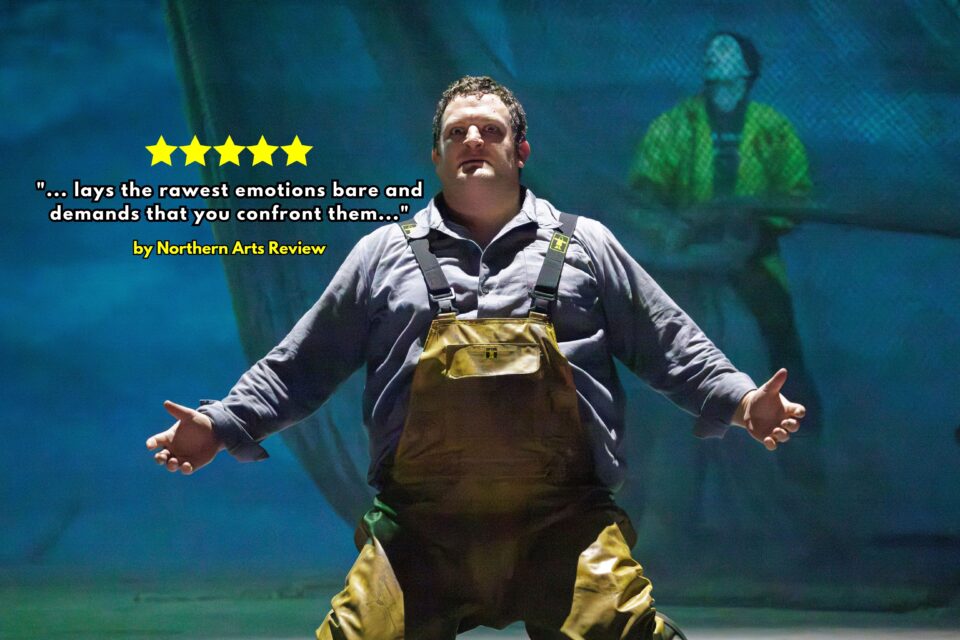
Peter Grimes - Northern Arts Review
Opera North at the The Leeds Grand
Peter Grimes - Northern Arts Review
I’m an ugly crier. And worse yet, I absolutely love crying. There is something about just letting it all go when immersed in a good book, watching a gut-wrenching film, or pummelling myself with heartbreaking opera—it’s like scratching an itch deep in my soul. So, it is no great surprise that when my friends heard I was going to see Opera North’s newest revival of Peter Grimes that they told me to bring a tissue—or ten.
They weren’t wrong. Benjamin Britten’s Peter Grimes has earned its reputation as an emotional powerhouse since its 1945 premiere at Sadler’s Wells, when it marked both the reopening of the theatre after the war and the beginning of what many consider the renaissance of English opera. Based on George Crabbe’s poem “The Borough,” the opera tells the story of Peter Grimes, a fisherman in a small coastal village who becomes increasingly isolated after the death of his apprentice, as the villagers band together to ostracise him. When the schoolteacher Ellen Orford helps him take on a new apprentice, the community’s suspicion and hostility deepen. It’s a story about who is on the outside and who is on the inside, mob mentality and the ways communities can destroy the people they’ve decided don’t belong. This revival of Phyllida Lloyd’s production, co-directed by Karolina Sofulak and Tim Claydon, features experienced tenor John Findon in the titular role and is conducted by Opera North’s Music Director, Garry Walker.
From the first moment, the production establishes the oppressive weight of communal judgment. The opera opens not exactly in silence, but in something close to it. The performers filter onto the stage without speaking, the soundspace created entirely by the creaking of floorboards and the shushing of feet sliding across wood. That haunting quiet, punctuated only by the sound of collective movement, becomes the baseline for life in the Borough, a community defined by its ability to move as one crushing force. Slowly, the shoal is broken, and we are drawn into a courtroom proceeding where Peter is on trial for the death of his apprentice.
Anthony Ward’s set design is powerfully minimal, serving both function and theme. With such a vast chorus on and off stage, space was essential, but the openness also evoked the immensity of the sea and the seclusion of a British fishing village. A painted ocean backdrop wrapped around the upstage, its depiction deliberately ambiguous. The white crests of waves could just as easily read as clouds when we were cliffside, evoking that liminal space where the difference between sky and water disappears. In a production deeply influenced by material, the choice of wooden pallets, carried and repositioned by the performers, became the physical vocabulary of seaside life. When laid flat, they’re promenades; held upright, they’re the bar of the courtroom; and stacked high, they form pub walls. Colossal fishing nets appear throughout, draping over the chorus or creating enclosures that speak as much to human entrapment as they do to catching fish.
To see my full review, please visit Northern Arts Review
See you in the shadows my loves,
Sean x