A Midsummer Night's Dream - Northern Arts Review
Head & Shakespeare’s Globe at the The Leeds Playhouse
A Midsummer Night's Dream - Northern Arts Review
Take Thomas Kidd’s The Revenger’s Tragedy, throw in Kubrick’s clinical white spaces, add Shakespeare’s A Midsummer Night’s Dream, and blend. The result would be astonishingly close to this striking co-production from Leeds Playhouse, Shakespeare’s Globe and Headlong Theatre. It’s a production that understands something I’ve long suspected: A Midsummer Night’s Dream is a darker play than we typically allow it to be, and leaning into that darkness reveals textures the usual manic pixie interpretations miss entirely.
I’m the first to admit that my relationship with A Midsummer Night’s Dream has always been complicated. Despite spending a lot of my drama and literary career in love with all things Shakespeare, I’ve often found productions of this play to be a let-down. There’s just something about the story that compels creatives to mistake zaniness for charm. There’s tyranny in this text alongside forced marriage, romantic betrayal, stolen children and failing crops. Yet so often interpretations are whimsical to the point of empty-headedness, and the result is a bizarre attention-seeking jester mode that makes me count the minutes until the interval. So, when I heard Headlong was taking a darker, almost horror-inspired approach, I was genuinely excited. Could this be the Dream I’ve been waiting for?
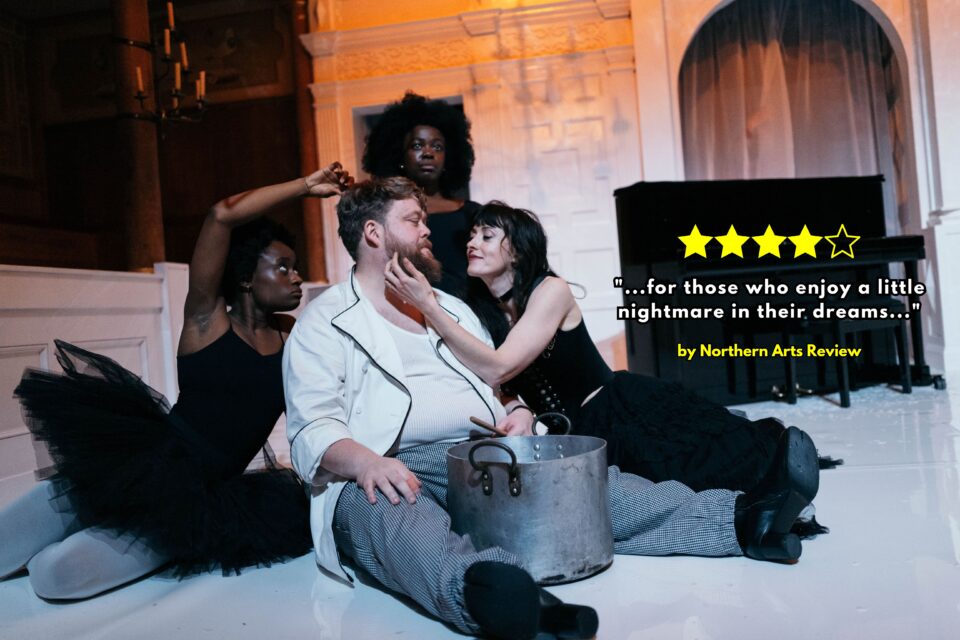
The play keeps to the familiar beats: Hermia loves Lysander but her father demands she marry Demetrius or face death. Lovers flee into the woods where the fairy king Oberon and queen Titania are in a bitter quarrel over a changeling child. Puck, Oberon’s trickster servant, is dispatched to fix everyone’s romantic woes but immediately makes everything worse. Meanwhile, Bottom and his friends rehearse a play for the Athenian Duke’s upcoming wedding. In Roughan’s adaptation, the mechanicals become palace staff preparing for the nuptials of Duke Theseus and his captive bride Hippolyta, with Bottom as the executive chef and Puck appearing as a sommelier.
Visually, the production was arresting. Max Johns’s all-white ballroom set had that Kubrickian quality, uncomfortably sterile and gleaming—an otherworldly space where colour stands out with unsettling intensity. The play opens with Puck perched on a banquet table in tense silence, eating a banana in the most menacing fashion possible. What follows is Gordon Ramsay-inspired Hell’s Kitchen chaos escalating into violence. Food is scattered, tables are overturned and weapons are drawn. Later, when the furniture clears, the space becomes a blank canvas that can be anything, and in this production, it is a nightmare.
To see my full review, please visit Northern Arts Review
See you in the shadows my loves,
Sean x