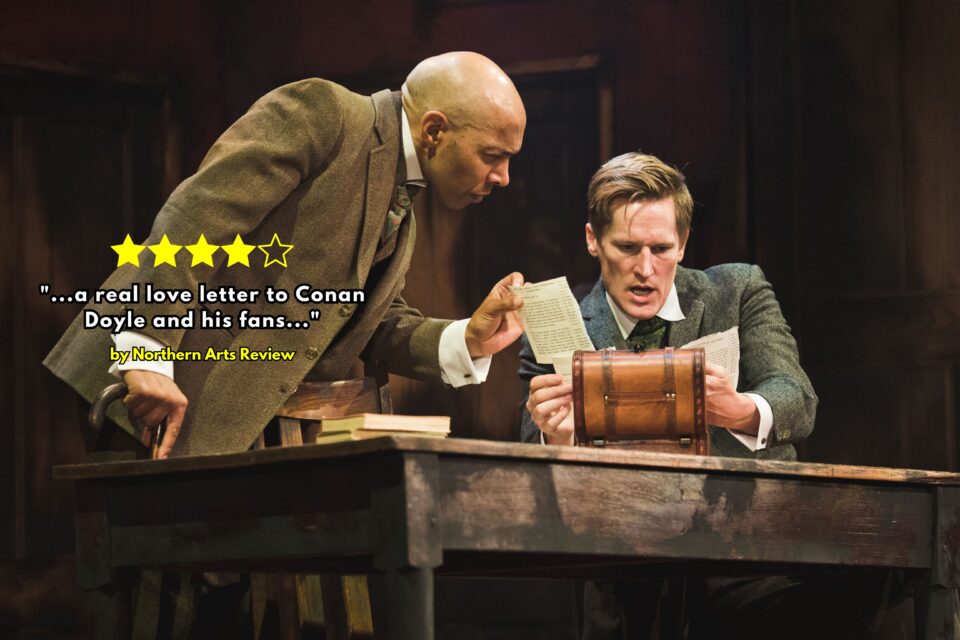
Sherlock Holmes: The Hunt for Moriarty - Northern Arts Review
Blackeyed Theatre at the Cast, Doncaster
Sherlock Holmes - Northern Arts Review
I am a professional woman of mystery. In my real-life secret identity, I am a writer and fiction editor whose primary genre is mystery. My day-to-day existence can be diagrammed on a corkboard covered in red strings and no bad guy under a mask will escape my detection. In fact, for the last twenty years, the game has never stopped being afoot. So, when the opportunity to visit my colleague Sherlock Holmes on stage comes up, the clues only point in one direction.
The Hunt for Moriarty is Blackeyed Theatre’s third adaptation of Arthur Conan Doyle’s work, and there’s a lovely local symmetry to it landing at Cast, as writer-director Nick Lane is Doncaster-born and raised. Rather than adapting a single novel, Lane has stitched together several of Doyle’s short stories—A Scandal in Bohemia, The Adventure of the Bruce-Partington Plans, The Adventure of the Second Stain, and The Final Problem—into one continuous meta-mystery. We are whisked away to London, 1901, and a shadowy conspiracy is ripping at the seams of government and monarchy alike. Holmes and Watson find themselves unsure who to trust, circling an old adversary waiting in the shadows. As someone who has read every Sherlock Holmes mystery, I was delighted by how much of Doyle’s flavour survived the transplant. From the clipped, forward-leaning energy of the prose to the dry repartee between Watson and Holmes, I felt squarely inside the pages of my favourite short stories. That said, Lane has allowed the script a little more of a knowing wink than the stories themselves usually permit, an instinct I thought worked well. After all, he knows what we Baker Street Irregulars really want: to feel part of the team.
Victoria Spearing’s set is a three-sided convertible construction, beginning in a burnt-out 221B Baker Street complete with dark red, fire-marked walls. It’s ingenious in concept: walls flip on hinges, and furniture gets rearranged, remaking itself into a succession of locations across two acts. My one frustration was that the base set, striking as it was, never quite felt lived in. No pot plants. No sense of soft furnishings. It was atmosphere sans domesticity. And because it started without a clear sense of somewhere specific, stripping it back for other scenes didn’t produce the sensation of arriving somewhere new. I kept feeling like I’d never really left Baker Street, even when I was allegedly in a men’s club or beside a railway. I wanted wallpaper. I wanted clutter. That way, when they disappeared, I could sense I was firmly somewhere else.
Oliver Welsh’s lighting did excellent work throughout, and there were definitely moments where his sense of light and shadow tickled my mystery bone. Silhouettes cast through doorways as characters approached, stretched against the set walls, gave the production a fantastic gothic atmosphere. At one point, a caretaker appeared with a raised lantern and an oddly affected voice, ready to take us somewhere unlit and ominous. And in that moment, I was living my best Scooby-Doo life.
To see my full review, please visit Northern Arts Review
See you in the shadows my loves,
Sean x