A Thousand Splendid Suns - Northern Arts Review
at the Leeds Playhouse
A Thousand Splendid Suns - Northern Arts
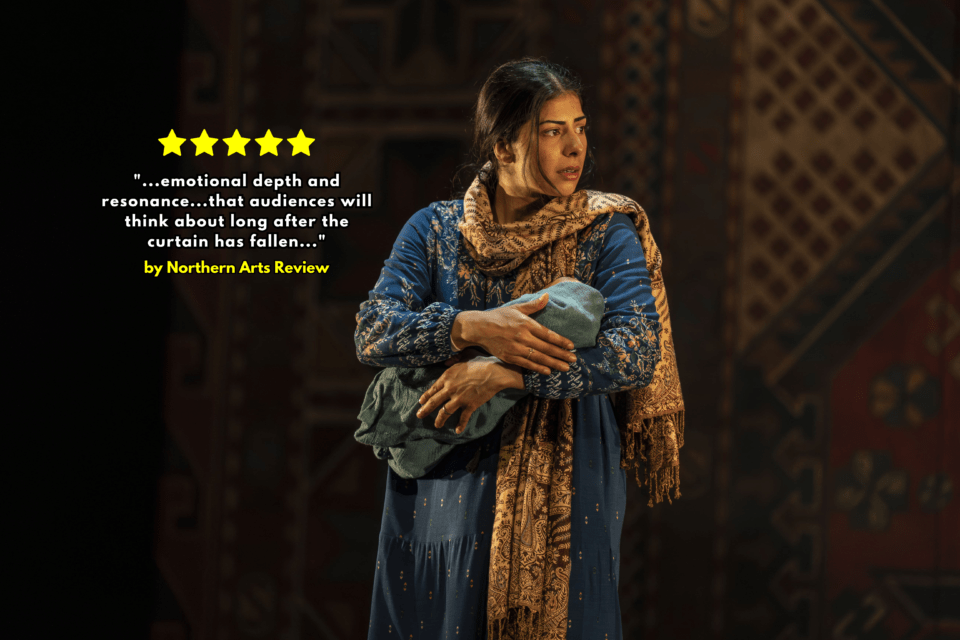
It’s rare to see an audience walk out of a theatre stunned into silence, not because the show was ambiguous or abstract, but because it cut so deep that words momentarily fail you. A Thousand Splendid Suns, presented by Leeds Playhouse in collaboration with Birmingham Rep and Nottingham Playhouse, is not an easy watch—nor should it be. But the emotional depth and resonance make it a show that audiences will think about long after the curtain has fallen.
Based on the novel by Khaled Hosseini and adapted for the stage by Ursula Rani Sarma, the story follows the intersecting lives of Mariam and Laila, two Afghan women, over nearly thirty years of war, repression, and personal sacrifice. Directed by Roxana Silbert, the production begins with the Soviet withdrawal from Kabul through the rise of the Taliban. A harrowing look at the struggle of women under extreme oppression, the story never loses sight of its emotional core—the evolving relationship between two women, bound by circumstance and, eventually, by love.
The staging is deceptively simple. Simon Kenny’s set is constructed from a series of raised octagonal platforms, designed to resemble a traditional Afghan rug. Behind, a second rug looms—literally—on a vertical frame, becoming a mountainscape when shown in silhouette. Later, the same rug becomes a haunting reminder of wreckage when twisted metal structures descend in the second half. It’s a design that does more with less—mirroring the struggles of the two women—creating distinct worlds through clever layering and movement rather than clutter.
Matt Haskins’s lighting plays a vital role in this transformation, casting ominous glows or intimate pockets of warmth, depending on where the story demands our attention. A single shaft of backlight or the sharp snap of a missile attack was often enough to send a jolt through the room.
Sound and music are equally evocative. Traditional Afghan music, composed by Elaha Soroor and Giuliano Modarelli, provides the piece an additional layer of emotional texture. Sometimes mournful, sometimes defiant, the music never overwhelms.
The costumes and makeup were understated but carefully crafted, especially in the way Laila’s wardrobe changes over the course of the play. From teenage girl to wife to mother living under Taliban rule, the progression is clear without ever being overstated. It’s a small detail, but in a story where clothing is literally used to control women, every small change carried outsized weight.
To see my full review, please visit Northern Arts Review
See you in the shadows my loves,
Sean x